

An AI voice agent that speaks, understands, and handles your customers' needs 24/7
Move past missed calls and frustrating hold queues. We integrate ElevenLabs' voice AI technology with your telephony systems, databases, CRM, and Google ecosystem to build a digital employee that works directly inside your existing infrastructure—right where your business runs.
Talk to our AI assistant
See for yourself how naturally and smoothly the assistant handles unexpected topic changes, interruptions, or requests for specific data. Experience how human-like conversational AI performs in practice.
When phone support becomes a bottleneck

Call spikes that paralyze your hotline
Seasonal surges (like Black Friday or the holidays) create massive hold queues. Hiring and training temp staff for just a couple of busy weeks is a logistical and financial headache.

After-hours missed calls
Your office closes at 5:00 PM, but customers want answers in the evenings and on weekends. Every unanswered call is a lost sale and a hit to your brand reputation.

Frustrating IVR phone menus
Traditional touch-tone phone menus ("press 1, press 5") can't understand what callers actually need. They loop customers endlessly, leading to frustration and abandoned calls.
What does a voice agent actually do?
At FOTC, we build digital employees who handle real, repetitive tasks for your call center. In practice, this breaks down into three key roles.

Answers (inbound calls)
Customers never have to wait on hold. The agent answers instantly, identifies the caller, understands their intent, and gets straight to resolving the issue. If a situation requires human intervention, it seamlessly transfers the call along with full context.

Calls (outbound calls)
Run hundreds of precise outbound calls simultaneously. Confirm appointments, send payment reminders, gather feedback, and deliver key updates while your team focuses on higher-priority tasks.

Gets things done in your systems
More than just a friendly voice, the agent integrates directly with your knowledge bases and core systems. It can independently check shipment statuses in your database, reschedule calendar appointments, or log support tickets in your CRM.
Average reduction in cost per handled call
Call answer rate, eliminating lost opportunities on hold
Routine inquiries resolved on first contact without human assistance
Average increase in customer satisfaction
Anatomy of an effective voice assistant
The voice you hear on the line is an impressive display of advanced speech technology. However, the real business value comes when the agent acts as a virtual employee executing tasks within your existing workflows. To make this possible, it relies on three integrated components working in unison.
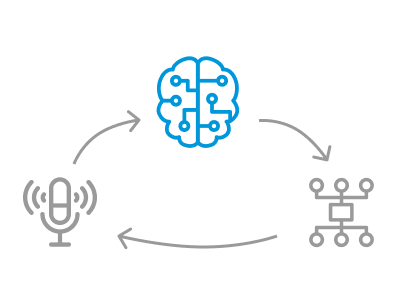
The language model serves as central command, handling logical reasoning, context connection, and information analysis.
- Understands natural conversation context without relying on rigid scripts—listening, analyzing, and responding fluidly.
- Smoothly handles complex statements, caller side-tracking, or sudden topic switches mid-call.
- Remembers key details from earlier in the conversation, combining facts to deliver accurate and helpful answers.
- Adapts dynamically in real time, tailoring follow-up responses based on details provided just moments before.
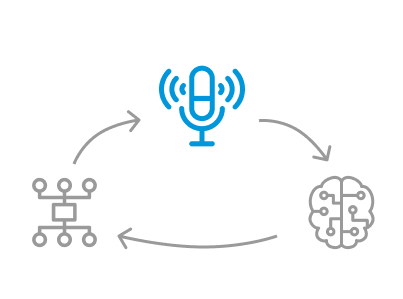
The speech synthesis engine (voice AI) that gives the agent a natural tone, making interactions feel human and comfortable.
- Detects emotion, hesitation, or frustration in the caller’s voice, automatically tuning its tone and pacing to match.
- Maintains a consistent brand identity, representing your company through a tailored voice personality.
- Eliminates unnatural, robotic pauses with ultra-low latency, ensuring seamless back-and-forth dialogue.
- Builds trust by giving callers the confidence of speaking with a trained professional.
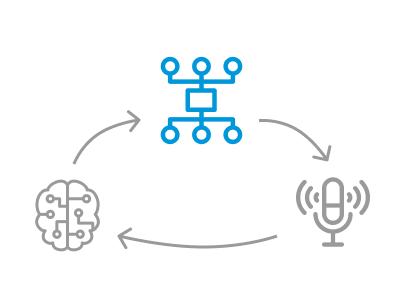
Our core contribution is connecting the brain and voice components directly to your technical infrastructure for reliable 24/7 operation.
- We securely connect the voice agent to your telephony, CRM, databases, ERP, and Google Workspace environment.
- We convert verbal requests into automated backend actions, enabling the assistant to log tickets, schedule meetings, or query databases instantly during the call.

Deploying an AI voice assistant with Fly on the Cloud
We don't just hand over platform software licenses and leave you to figure out the setup. We deliver a complete, turn-key integration project. Our team works alongside yours to take full responsibility for making sure your assistant runs smoothly. Partnering with us means onboarding a fully operational digital employee—not a DIY kit.
Custom-built solutions
Integration with your phone system and website
We connect the agent to your hotline and embed it on your website as a widget (it can function as both a voice bot and a chatbot).
Connection with your tools
Integration with your line-of-business systems (both off-the-shelf and custom). Based on API technical documentation, we seamlessly integrate the agent so it can fully support your unique, complex business process.
Security and performance included as standard
We design system architecture and concurrent call capacity around your peak traffic requirements. Data residency and retention parameters are established upfront during initial discovery.
4 reasons to build next-generation voice bots with FOTC
Seamless integration into your operations
We work around your existing workflows. We connect the assistant to your phone lines and current tool stack without disrupting IT operations, taking the load off your team while ensuring human escalation remains easily accessible.
Proven tech with clear standards
We build on industry-leading platforms (Google Cloud, ElevenLabs) while keeping full control of infrastructure and conversation logs in your hands. Billing is based on transparent engineering time—you pay for actual results.
Data stays in Europe
Unlike standard SaaS setups, our enterprise integrations guarantee that data stays stored within the European Economic Area (EEA) to meet your compliance standards.
Post-implementation maintenance
Deployment is just the starting point. As language models advance and business needs shift, we continuously maintain and refine your agent to maximize ongoing return on investment.
Industry-leading voice AI from ElevenLabs, powering over 4,000,000 AI agents
We don't experiment on your customer base. Your voice assistant is powered by ElevenLabs—a global leader in conversational voice AI trusted by millions of organizations worldwide.
They pioneered natural-sounding AI speech with authentic tone, subtle emotional nuance, and zero lag, redefining automated customer service.

How ElevenLabs technology transforms your call operations

No more awkward silence
An ultra-low latency of just 75 ms eliminates unnatural delays, keeping conversation flow as quick and lively as speaking with a human representative.

Natural interruptions
Callers can interrupt the assistant naturally to change the subject, and the system instantly adjusts its response based on the new request.

Emotional intelligence that calms callers
The system reads emotional cues in the caller's voice and adjusts its tone accordingly. Frustrated callers hear empathetic, composed responses instead of rigid script reading.

11,000 voices across 70 languages
A massive voice collection allowing you to select the precise tone, accent, and personality that aligns with your brand voice.
Where do AI voice agents deliver the highest and fastest ROI?
A transparent process from concept to full deployment
Discovery
We evaluate your phone workflows, databases, and IT stack to select high-impact processes for fast ROI. At this stage, we establish integration boundaries and data compliance requirements.
Proof of Concept
We build a working prototype agent in an isolated test environment. Your team tests the assistant hands-on across real-world call scenarios, refining tone, knowledge boundaries, and responses before public launch.
Measuring results
We launch the assistant on a controlled call volume to gather real performance data. Analyzing every interaction helps us remove friction points and fine-tune behavior based on actual customer responses.
Scaling
Once the prototype meets target metrics and proves cost savings, we expand the agent to full call volume and additional business lines—delivering a turn-key solution with ongoing maintenance and optimization support.
Let's discuss transforming your phone support
Explore next-generation voice AI. Let's talk about building a digital employee that handles customer requests seamlessly in the background of your business systems.
FAQ – honest answers, no overpromises
An AI voice assistant (the modern, conversational step beyond traditional voice bots) is an intelligent system capable of carrying on real-time, natural phone conversations with callers.
Voice assistants are generally grouped into two categories:
1. By call direction (inbound vs. outbound):
- Inbound voice assistants handle incoming caller traffic—answering instantly, verifying identity, answering questions, or resolving service requests.
- Outbound voice assistants place outgoing calls automatically to confirm appointments, send payment reminders, screen leads, or conduct satisfaction surveys.
2. By interaction style (conversational vs. process-driven):
- Conversational assistants conduct open-ended, natural dialogue. Callers can interrupt, ask follow-up questions, or change the topic fluidly while the assistant manages tone, hesitation, and speech pace. Best for complex, open-ended, or advisory discussions.
- Process-driven assistants operate like intelligent voice forms, guiding callers step-by-step through a fixed workflow to collect precise information. While less open-ended, they offer high consistency and data accuracy (ideal for claims processing, outage logging, etc.).
System guardrails and prompt engineering prevent the agent from fabricating information. If a caller asks something outside the assistant's knowledge base, it politely explains the limitation and transfers the call to a human team member along with the full transcript context.
Not at all. We avoid major operational overhauls from day one. We recommend starting with a single, clear use case (like appointment confirmations or order lookups) through a Proof of Concept (PoC). Likewise, we test on a small call volume, measure clear ROI metrics, and scale based on verified success.
Setting up a basic voice and document upload in the ElevenLabs dashboard works fine for initial testing, but real business value requires system integration. The agent must handle live phone calls via your VoIP provider, look up records in your CRM, and create tickets in platforms like Zendesk or Jira. Standard self-service accounts often process data outside the EU, whereas FOTC delivers enterprise architecture, European data compliance, failover mechanisms, and system integrations. As ElevenLabs' primary implementation partner in the region, we bring in-depth experience deploying production-ready AI assistants.
We deliver a complete integration and maintenance solution rather than a standalone tool.
Our engagement model covers three core areas:
- Implementation – technical build and integration engineering tailored to your requirements.
- Technology usage – direct or re-invoiced usage costs for the underlying language models and ElevenLabs voice engine.
- Maintenance & optimization – ongoing service retainers covering prompt updates, knowledge base expansions, and performance tuning.
Every call generates actionable data, including transcripts, optional audio recordings, call outcomes, and escalation reasons. This data streams directly into your Google Cloud environment to populate custom dashboards (such as BigQuery and Looker Studio). You retain full ownership of all analytics assets. Monthly reports track key operational metrics: deflection rate, escalation reasons, call duration, and knowledge gaps.
You maintain full ownership of your data, retention settings, agent prompts, and analytics setup. Model updates are managed as explicit configuration settings rather than silent automatic updates. Before upgrading model versions, we run regression tests to ensure consistent response quality.
Yes. An agent uses a single unified knowledge base across multiple channels, including phone lines, web chat, WhatsApp, and SMS—ensuring consistent answers regardless of how customers get in touch.
When website chatbots underperform, the issue is usually missing backend integrations rather than text comprehension. While simple text bots only display static FAQ answers, an integrated voice and chat agent can update orders, reschedule appointments, and log tickets automatically.
We build on what works. If your current text bot is performing well, we focus on voice integration and connect both to a unified knowledge source. If the text bot needs improvement, we evaluate consolidating both channels onto a single platform during initial discovery.
Yes. Data security and GDPR compliance are core design requirements. Our deployment architecture processes and stores data within the European Economic Area (EEA), and we maintain compliance with the EU AI Act by disclosing AI interaction at the start of every call.
Project scope depends on process complexity and backend integrations. A standard RAG-enabled voice agent with 2–3 system integrations typically takes 12 to 20 engineering days. Following initial discussions, we provide a detailed project scope and timeline within 10 business days.
Virtually any platform with a secure API. We regularly integrate with systems across:
- Telephony & VoIP – connecting voice assistants to existing phone switches via Asterisk, Genesys, Twilio, or standard SIP trunks.
- CRM & ERP – integrating agents with Salesforce, HubSpot, Pipedrive, custom SQL databases, and billing software.
- Ticketing & Productivity Suites – linking workflows with Jira, Zendesk, and the Google Workspace suite (Gmail, Calendar, Drive).
- Industry-Specific Software – connecting agents with domain-specific resources and operational platforms.
ElevenLabs provides enterprise-grade infrastructure with strict security measures, holding major compliance certifications:
- Certifications & Standards – ISO 27001 certified, SOC 2 Type II audited, PCI DSS compliant, and CSA STAR aligned.
- Security Audits – regular third-party penetration testing by independent cybersecurity firms.
- Privacy & Compliance – fully aligned with EU GDPR and US HIPAA standards, offering guaranteed EEA data residency on enterprise tiers.
- Zero Data Retention – option to purge call audio and data immediately upon call completion for sensitive workflows.
- Voice Protection – verification workflows governing voice cloning to prevent unauthorized use.
Not every phone process benefits from automation. We provide upfront guidance if a project isn't a fit, advising against deployment when:
- Call volume is low – under 1,000 monthly calls per process makes ROI payback take longer than 12 months (unless high-value lead conversion offsets costs).
- Conversations lack repeating patterns – voice agents excel at structured, repeatable processes. Without recurring call patterns, building a strong ROI is difficult.
- Core systems lack API support – without API access, an agent cannot perform backend tasks, turning it into a simple answering machine.
- No internal process lead – projects require a dedicated owner to clarify workflow edge cases and validate logic during setup.
- High-stakes decisions are involved – medical diagnoses, legal counsel, or financial approvals should always remain in human hands.